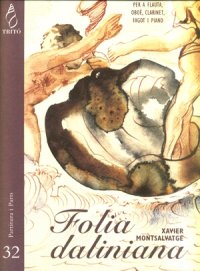
Solo flute, oboe, clarinet, bassoon. String orchestra and percussion.
27-07-1996: Orquesta de Cadaqués. Sir Neville Marriner, conductor. Esglèsia de Cadaqués. Festival de Música de Cadaqués, Girona.
Comission by the Orquestra de Cadaqués.
Also version for flute, oboe, clarinet, bassoon and piano.
Comments
This piece was inspired by the life and work of the painter Salvador Dalí; Montsalvatge wanted to evoke the depth of Dalí’s indentification with the special ambiance of Cadaqués and its surrounding landscape which always served as source of inspiration for him. Montsalvatge bases his Folia Daliniana on the Folia de España, a dance based on a simple harmonic progression that was very popular in Spain and Portugal during the Renaissance.
Douglas Riva, 1999.
With the Folia Daliniana we enter the composer’s most recent creative period. It is scored for four solo instruments and orchestra or piano and, according to the composer, is a free adaptation of dances which originated in Portugal and were called Folias de Espanha. There are three basic points of interest: the presence of the folia in the lively rhythms, the presence of the four solo instruments—flute,oboe, clarinet and bassoon—that succeed one another in developing their role as soloists, and a highly personal musical language which includes atonalism and Caribbean-inspired elements which we can hear in the distance.
Xosé Aviñoa, 1999.
"In this version of the Folia, related in a way to the memory of Salvador Dalí, I wanted the four solo instruments to be essentially predominant; they play together at the beginning and the end and then, each one -flute, oboe, clarinet and bassoon- takes on its role in the middle section, one after the other, as a veritable soloist, clearly highlighting the virtuosic character of each one of them."
Xavier Montsalvatge, 1997.